
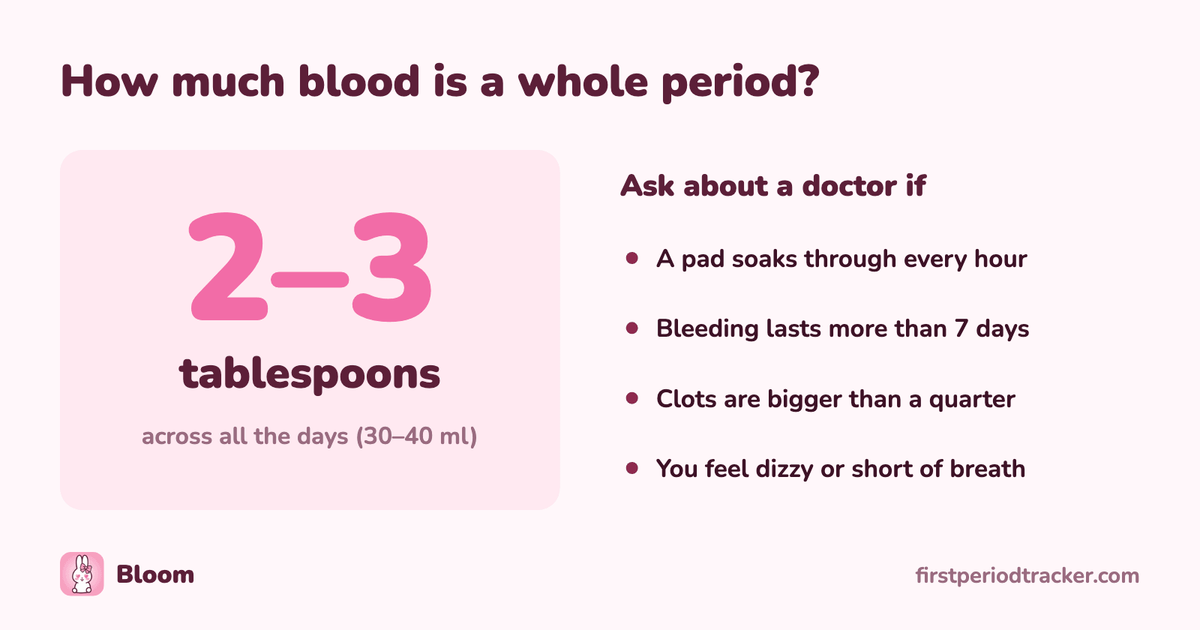
A typical period is about 2 to 3 tablespoons of blood across all the days added together. That is roughly 30 to 40 milliliters. It looks like more in the toilet or on a pad because it mixes with fluid from the lining of the uterus, and because a pad spreads it out.
A first period is often less than that. Some first periods are a day of brown spotting. Length and amount for that very first one are in how long a first period lasts.
What a normal day looks like
Most people change a pad or tampon a few times a day. A regular pad lasting three to six hours on the heavier days, and longer on the light days, is an ordinary period.
Day one or day two is usually the heaviest. The last days are often brown and light. Brown on that first heavier day is still normal. Color is covered in is your first period brown.
You cannot measure tablespoons at home, and you do not need to. Pad changes are the practical version of the same question.
When it is a lot
Ask a parent about a doctor if any of these are true:
- You soak through a pad or tampon every hour for several hours
- You bleed for more than 7 days
- You pass clots larger than a quarter, again and again
- You feel dizzy, very tired, or short of breath during your period
- You wake up at night to change protection most nights of the period
That pattern has a medical name, heavy menstrual bleeding. It is common enough that doctors see it often, and it is treatable. It is not something to handle by layering three pads and hoping.
What does not tell you the amount
A gush when you stand up after sitting in class is usually blood that pooled while you sat. A stain on underwear or sheets looks huge and is often a few teaspoons. Neither one, by itself, means the period is dangerously heavy.
Cramps and amount are related but not the same. A light period can still hurt. If day one is the worst, that is the usual shape, and the cramp toolkit is the practical list.
If this is one of your first periods
The first years are uneven. One period can be two brown days. The next can be a fuller week. A gap of several weeks, or two bleeds in one calendar month, can both be normal while cycles settle. Irregular periods at first is the longer version.
Still tell an adult if you are soaking a pad every hour. “It’s my first year” is not a reason to ignore heavy bleeding.
Keeping a simple count
You do not need a chart of milliliters. “Changed a pad four times” or “only a liner” is enough. Bloom is a period app made for first periods: no account, and everything stays on your phone. Learn is free forever; tracking has a short free peek, then an optional subscription.
This is general information, not a diagnosis. A doctor is the person who decides whether an amount is a problem for your body.